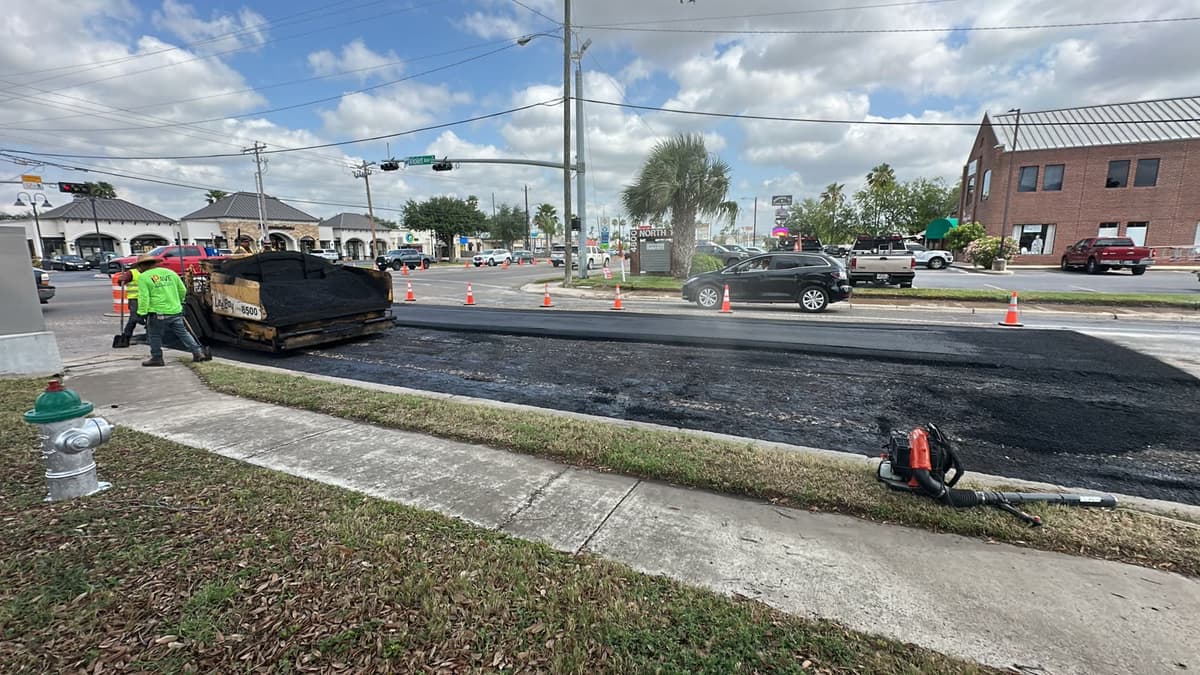
Edinburg is one of the fastest-growing cities in Hidalgo County. New residential developments are spreading along US-83 and Freddy Gonzalez Drive, the UTRGV campus keeps driving demand for apartments and rental investment properties, and established older neighborhoods near downtown are seeing serious reinvestment. Maybe you're building new construction, replacing a cracked or settled driveway, or improving a rental property to compete in a tighter market. Here's what paving actually costs in Edinburg in 2026, and what you need to know before you hire someone.
Concrete vs. Asphalt: The Main Decision
This is where most homeowners start, which material is right for my property? In Edinburg, the answer is almost always concrete. Here's why.
| Material | Cost per Sq Ft | Lifespan (South TX) | Maintenance |
|---|---|---|---|
| Concrete (standard broom finish) | $6–$10 | 20–30+ years | Minimal |
| Concrete (stamped/decorative) | $12–$20 | 20–30+ years | Occasional sealing |
| Asphalt | $3–$7 | 10–15 years | Seal every 3–5 years |
| Chip seal (overlay) | $2–$5 | 8–12 years | Limited use cases |
Concrete costs more upfront, but in South Texas heat, it outperforms asphalt significantly. Asphalt softens in 100°F+ temperatures, and Edinburg sees those temperatures for months at a stretch. A properly paved asphalt driveway that holds up in Dallas will develop ruts, soften, and show tire marks in Edinburg under regular use. Asphalt also needs sealing every 3–5 years to maintain it. Concrete, by contrast, doesn't soften in the heat, requires minimal maintenance, and on a well-prepared base will last 25 to 30 years.
A typical 2-car concrete driveway (400 sq ft) runs $2,400–$4,000 at standard broom finish. Stamped or exposed aggregate runs higher, $4,800–$8,000 for the same footprint, and makes sense for homes where curb appeal matters.
Asphalt makes sense for certain situations: larger commercial parking lots, long rural driveways where per-foot cost matters, or when the budget is the binding constraint. It's also slightly faster to install than concrete. For a 400 sq ft residential driveway, you're looking at $1,200–$2,800 for asphalt, noticeably cheaper upfront, but factor in resealing costs and a shorter lifespan before you decide.
Chip seal is a gravel aggregate pressed into an asphalt emulsion, a budget option sometimes used for long ranch roads and rural commercial lots. It's not appropriate for tight residential driveways. The surface is rough, it tracks gravel onto roads, and it doesn't hold up to the stop-and-turn patterns of daily home use.
Edinburg Soil Conditions: What Every Contractor Here Needs to Know
The soil throughout Hidalgo County, and Edinburg is no exception, is predominantly expansive clay. This soil swells when it absorbs moisture and contracts when it dries out. It's the primary reason driveways in the RGV crack and settle, and it's why base preparation is not optional.
When you get competing bids, you'll often see a wide spread in price. Some of that reflects material differences. Some of it reflects a contractor who is skipping base prep. A contractor who excavates to proper depth, compacts the subgrade, and installs a proper caliche base layer costs more than one who pours concrete directly over whatever is there. The cheap bid saves you money on day one and leaves you with a cracked, settled surface in 3–5 years.
For residential driveways in Edinburg, the minimum standard is:
- 4-inch concrete slab with #3 rebar on an 18-inch grid
- Proper subgrade excavation and compaction
- Caliche base layer
On soft clay lots or areas with known drainage issues, 5-inch slab thickness with rebar is the better choice. Control joints placed at the right intervals allow the slab to move predictably without random cracking.
When you get a bid, ask the contractor to specify slab thickness, rebar size and spacing, and what they're doing for base prep. A contractor who can't or won't answer those questions specifically is a contractor you should pass on.
Permits in Edinburg
The City of Edinburg requires permits for new driveway construction and significant modifications. The permit process connects to right-of-way access at the street, the curb cut, which is regulated by the city. Installing or modifying a driveway without the appropriate permit can create complications when you sell the property.
Contact the City of Edinburg Public Works / Development Services department for current permit requirements and fees. Your contractor should be pulling the required permits as part of the project scope, that's standard practice for a licensed and insured contractor. If a contractor tells you permits aren't necessary or suggests you skip them, that's a red flag.
What to Look for in a Paving Contractor in Edinburg
Texas does not require a state-level general contractor license, anyone can call themselves a GC. What you can verify:
- General liability insurance at minimum $1M per occurrence, ask for a Certificate of Insurance
- Workers' compensation: if a worker is injured on your property without workers comp in place, you can have exposure
- Experience with Hidalgo County soil specifically: a crew that normally works in Houston or San Antonio may not have the same familiarity with expansive clay conditions in the RGV
- Written scope that specifies base prep methodology, rebar size and spacing, slab thickness, and control joint placement
- Permit pulling included in the project
Get at least two bids and ask both contractors the same technical questions. The answers will tell you a lot.
Frequently Asked Questions
How long does a driveway last in Edinburg? Concrete: 20–30+ years with proper base prep and control joints. Asphalt: 15–20 years in moderate climates, realistically 10–15 years in South Texas heat with regular sealing. The lifespan of either material depends heavily on how the base was prepared, a concrete driveway on a poor base can fail in 5 years.
How long until I can drive on a new concrete driveway? You can walk on new concrete after 24–48 hours. Wait 7 days before driving on it. Full cure strength is reached at 28 days, avoid heavy vehicle loads until then.
Does the RGV heat affect concrete installation? Yes, and it matters. Pours should be scheduled for early morning before temperatures exceed 90°F. After finishing, curing compound is applied immediately to slow surface moisture loss. If the surface dries too fast, you get shrinkage cracks at the surface, sometimes called "plastic shrinkage cracking." An experienced crew working in Edinburg knows this and accounts for it. A crew that learned to pour concrete in a cooler climate may not.
Can I pull the driveway permit myself, or does the contractor handle it? Either can work. In practice, licensed local contractors typically pull permits as part of their standard service, it's built into their process. If you pull it yourself, you become the responsible party, which affects inspections and any warranty claims.
What's the difference between a standard broom finish and stamped concrete? Broom finish is the standard residential finish, the surface is dragged with a broom while the concrete is still wet to create a slightly rough, slip-resistant texture. It's practical and durable. Stamped concrete uses patterns pressed into the surface to create the look of stone, brick, or tile. It costs more and requires occasional sealing to maintain the appearance, but adds significant curb appeal for homes where that matters.
365 Builders provides concrete flatwork and paving services in Edinburg and throughout Hidalgo County. We know the soil conditions, we handle the permit process, and we're not going anywhere, we've been working in this area for over a decade. Call (956) 607-0470 or request a free estimate.